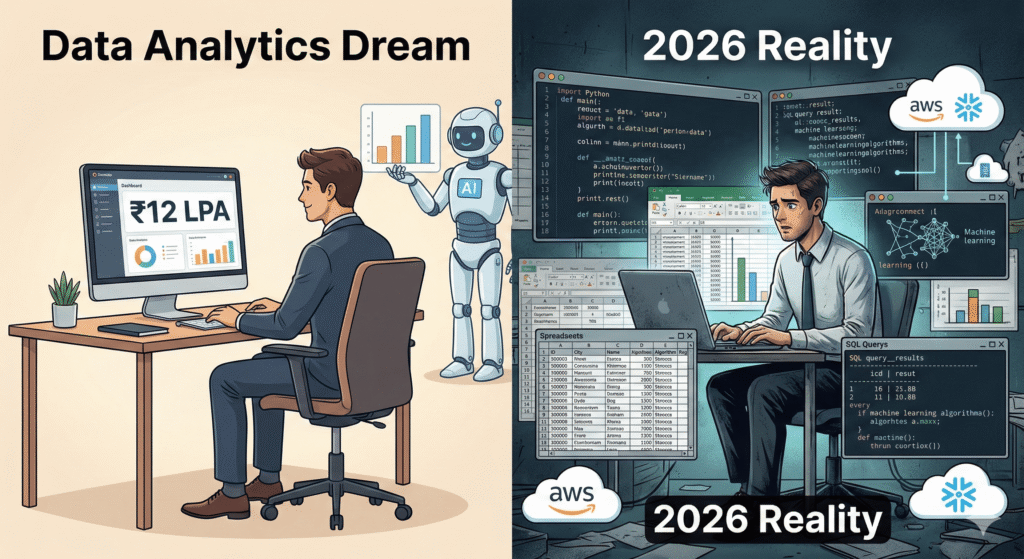
Data Analytics in 2026: The Truth About the Hype
Hey, great finding you here. It looks like you are trying to upskill yourself to become more employable, and someone has pitched you the Data Analytics Dream.
Easy and CTC heavy
But know that both cant be true at once.
You know the pitch: sit at an AC desk, play around with Excel and Power BI, and easily bag a minimum starting salary of ₹6 LPA, with an average of ₹12 LPA. Sounds amazing, right?
Let’s unfold that pitch and give you a reality check.
First, Evaluate Yourself: Who Are You?
The EdTech industry loves to sell one generic course to everyone, but entering this field works very differently depending on who you are.
- A student in college or just passed +2: You have the time to learn the heavy tech skills, but you have zero business context. Data analysis is useless if you don’t understand how a company actually makes money. You have to learn the business side alongside the tools.
- A corporate guy wanting a tech pivot: You already know how a business runs (sales, marketing, operations). Do not start from zero. Your unfair advantage is your domain knowledge. You just need to learn SQL and Python to automate and analyze the metrics you already understand.
- Someone with a career gap: Listen carefully. You will surely face the question in the interview: Why do you have a gap, and why should we hire you? Be prepared. Never walk in with the attitude of I know Excel, SQL, and Python. Guess what? A thousand other applicants know them too, without any gap in their careers. A bootcamp certificate will not save you. You need a brutal, undeniable public portfolio solving real-world business problems to even get an HR to look past that gap. Prove you can execute, or don’t even bother applying.
The Boring Stuff: What Actually is Data Analytics?
As the name says, it means the analysis of data to extract business insights. The traditional pitch tells you to learn Excel, pick up a BI tool (Power BI or Tableau), and learn SQL. That is what a typical Data Analytics course sells you.
But data analytics in 2026 is way more advanced than you think.
Welcome Your New Competitor: Artificial Intelligence
Before diving deeper, let’s invite the main guest of this topic. AI (Your competitor)
Yes, AI can now do 90% of your basic Excel work. You just plug Copilot into Excel or Gemini into Google Sheets, type a prompt, and the data is cleaned and pivot tables are made. A little automation with JS or Python can solve 60% of the standard visualization requirements in Power BI.
If all you know is basic Excel and how to make a bar chart, you are entirely replaceable.
So, is Data Analytics Dead in 2026?
Not really. But it demands more.
The industry no longer just asks for SQL and Excel. A real, employable data analyst in 2026 needs:
- Python & Statistics: For heavy data manipulation.
- Machine Learning Fundamentals: You need to do Exploratory Data Analysis (EDA) and use predictive analytics. You must understand how ML algorithms work.
- Cloud Analytics: You need to know how to build pipelines in cloud platforms like AWS, Azure, or Snowflake.
When you know these things, AI becomes your helper rather than your competitor. AI can write a Python query or generate an ML algorithm, but it cannot replace a human completely. You still have to understand the code, understand the business requirement, and execute the logic yourself.
| The Metric | The EdTech Pitch | The 2026 Reality |
| Core Tools | Excel, SQL, Power BI | Python, SQL, Snowflake, ML Basics |
| Your Role | Making charts and dashboards | Predictive analytics & cloud pipelines |
| Starting Salary | Minimum ₹6 LPA | ₹3 LPA to ₹5 LPA (Unless you are top tier) |
| AI Threat | AI won’t replace you | AI will replace you if you only know Excel |
The Bootcamp Trap: Should You Buy That Course?
So, the bigger question: if a course contains all these advanced topics, should you immediately buy it?
Not really.
Industry data suggests that approximately 10000 new learners enroll in data analytics courses each month across all platforms. Huge number, right? 😅
But relax, everyone is not your competitor. 90% of them drop out in the middle. Why? Because Python logic doesn’t sit well with everyone, and advanced SQL gets confusing really fast.
The Final Verdict
Don’t just chase the hyped salary; think before investing your money. Keep the josh high, but start smart. Buy a cheap Python for Data Analytics course on platforms like Udemy or Coursera for a few hundred rupees. Try coding, build the logic, and spend 1 to 2 months testing the waters. If you actually enjoy it, then think about investing further.
But keep this in mind: don’t fall for overpriced bootcamps. Paying anything above ₹15,000 is simply too much for data analytics in 2026 when you have an ocean of free and cheap resources available online.
No comments yet.
Be the first to share your thoughts.